AIBID BLOG

AI & Tech

Latest AI products, models, agents, robotics, chips, funding and open source.

Developer Tools · 10 d ago

GitHub Brings Copilot Agentic Skills into Slack Public Preview

What happened

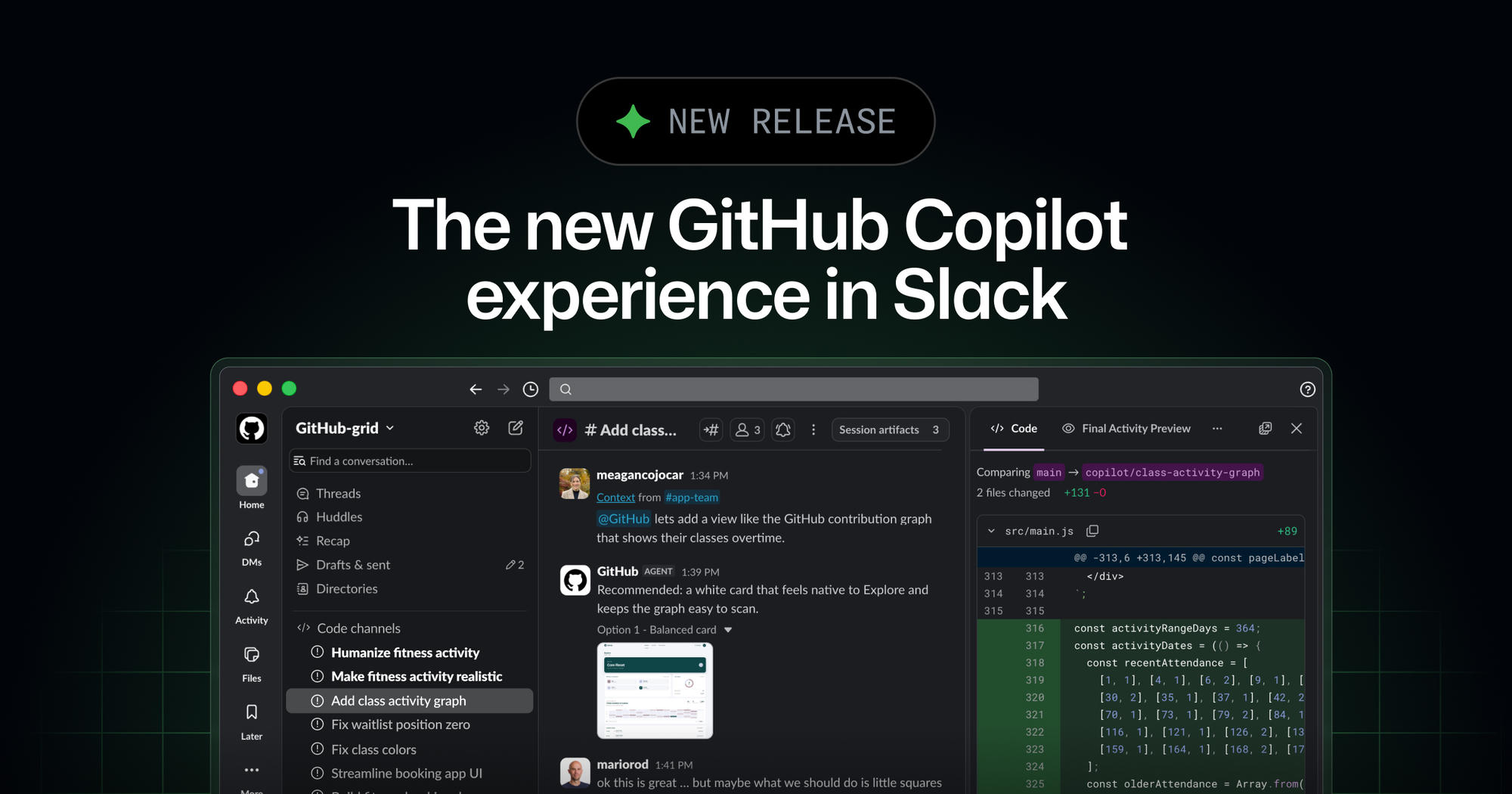
GitHub has updated its Slack integration so that the agentic capabilities of GitHub Copilot CLI and the GitHub Copilot app are now available inside Slack.

The new experience is being offered in public preview.

Users can interact with the @GitHub handle in Slack as part of the feature, according to the GitHub Changelog post.

Why it matters

Bringing Copilot's agentic skills into Slack positions GitHub's AI assistant in a space where teams already communicate and coordinate work.

By offering a public preview, GitHub is likely exploring how developers will use these AI-driven workflows in conversational settings before expanding access more broadly.

Key facts

The GitHub integration in Slack now supports agentic capabilities from GitHub Copilot CLI and the GitHub Copilot app.

The new GitHub Copilot experience in Slack is available in public preview.

Users can work with @GitHub in Slack as part of this integration.

What to watch next

More details may emerge about the specific actions users can take with @GitHub in Slack, since the announcement appears to continue beyond its opening description.

The public preview may evolve as GitHub gathers feedback and potentially expands Copilot's Slack capabilities.
Sources

Read → Keep scrolling for the next story
Developer Tools · 10 d ago

GitHub Copilot and Microsoft Teams: Shared Agentic Sessions

What happened

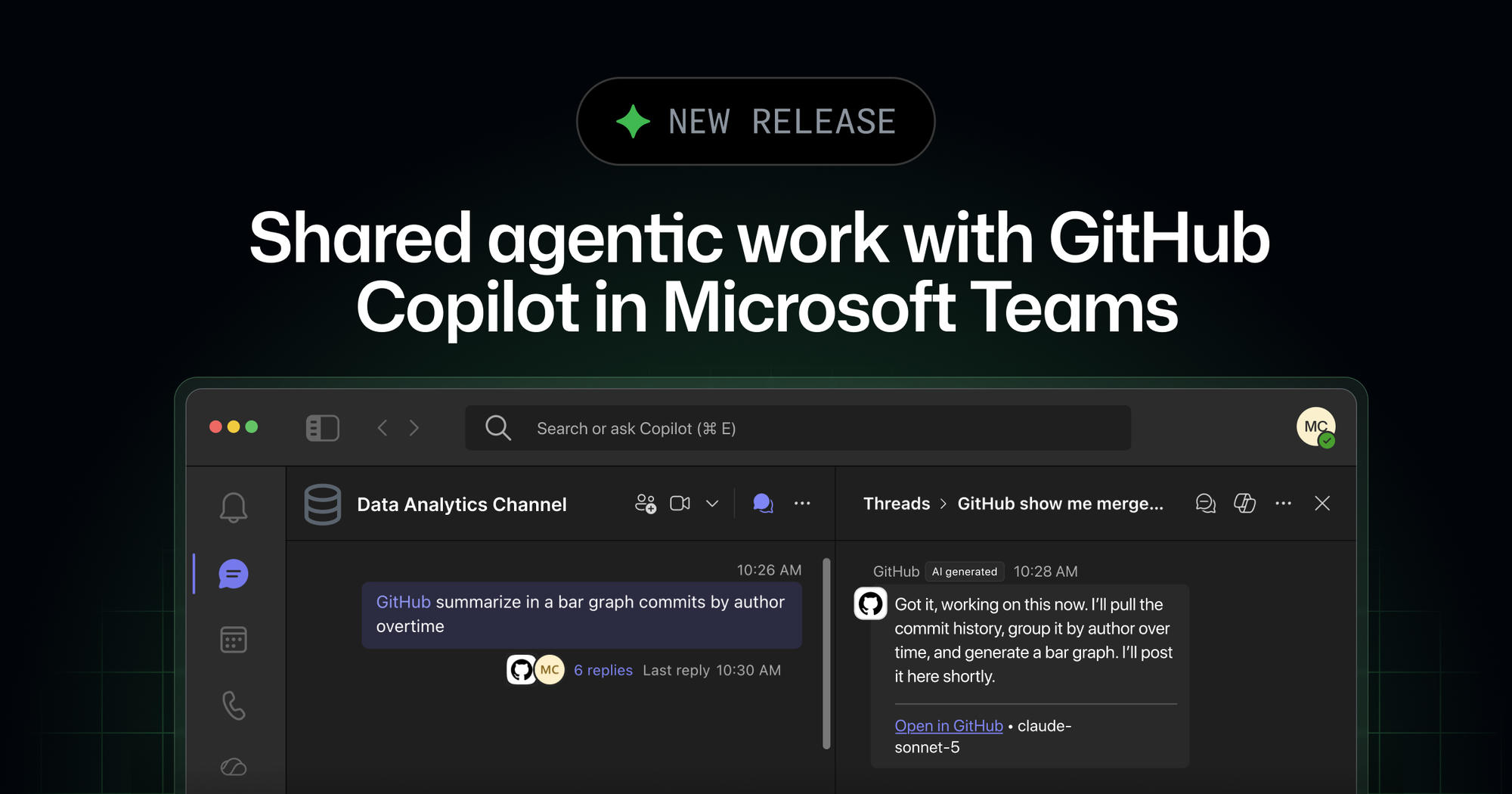
GitHub announced a new integration that brings shared agentic work with GitHub Copilot into Microsoft Teams.

Users can transform a Teams discussion into a collaborative agent session that everyone can see and help direct.

A session is started by mentioning @GitHub in a channel, thread, or direct message.

Why it matters

This shifts GitHub Copilot from a private assistant toward a team-oriented tool where group members can jointly guide the agent.

Making the session visible to all participants encourages shared context and collective oversight of agent actions.

Key facts

The feature is described as shared agentic work with GitHub Copilot in Microsoft Teams.

A Teams discussion can become a collaborative agent session available for everyone to see and direct.

Users initiate the session by mentioning @GitHub in a channel, thread, or direct message.

What to watch next

The announcement does not provide further details on what happens after the @GitHub mention or how the session is managed.

GitHub may release additional changelog entries explaining session permissions, limitations, or collaborative controls.

Sources

Read → Keep scrolling for the next story
Enterprise AI · 10 d ago

How AI agents can delegate better

What happened

Google Cloud is applying classic organizational leadership lessons to AI agents, arguing that multi-agent systems work best when the agents themselves can decompose and assign complex tasks effectively.

Drawing on Google DeepMind's 'Intelligent AI Delegation' study, the company highlights principles for delegation: verifying delegated work through contract-first decomposition, being cost-aware when routing tasks, and respecting sensitive data through minimal permissions.

Why it matters

As enterprises move from single AI assistants to multi-agent workflows, the quality of orchestration becomes critical. These principles position delegation not as simple task assignment but as an intelligent act involving planning, cost trade-offs, and security boundaries.

The emphasis on verification and human judgement suggests a future where agentic systems are designed with explicit checkpoints for human oversight, helping businesses decide where automation and where expert review are most valuable.

Key facts

Google Cloud says AI agents need to become good delegators to handle complex enterprise workflows.

The research framework from Google DeepMind's 'Intelligent AI Delegation' shows delegation involves intelligence, including adaptive negotiations, formal contracts, and security guardrails.

Principle 1, contract-first decomposition, calls for breaking work into tasks that can be reliably verified, with subjective assessment reserved for where human judgement is needed.

Principle 2 advises matching tasks to the right model size, using smaller, cheaper models for simple jobs and stronger models for complex ones, often via API gateway model routing or proxies like LiteLLM.

Principle 3 requires agents to grant only the minimum permissions necessary, avoiding the transfer of full sensitive data to sub-agents to protect security and context window performance.

What to watch next

Adoption of model routing and least-privilege patterns is likely to grow as organizations scale multi-agent deployments and push for cost efficiency.

Google Cloud says four principles emerged from the research, with three detailed in this announcement; the remaining principle may be explored in the original publication.

Sources

Read → Keep scrolling for the next story
Enterprise AI · 10 d ago

Google Cloud roundup: agent identity, AI database migrations, GPU savings, and more

What happened

Google Cloud has consolidated its latest updates into a single hub, covering announcements, resources, events, and learning opportunities. One highlighted item is an August 27 webinar on agent identity, led by Product Manager Shaun Liu, which addresses how stolen API keys can make malicious agents look legitimate and why static credentials and legacy IAM policies struggle to keep up with machine-speed execution.

The hub also features the All Things Agentic Hackathon, open for submissions until August 31, 2026, with a share of $190,000 in prizes; a Database Migration Service capability that uses Gemini for AI-assisted code conversion to PostgreSQL and AlloyDB; Compute Flex CUDs for G2 and G4 GPU VMs; and the GCSFS 2026.8.0 release with adaptive concurrent prefetching.

Why it matters

Agent identity is becoming a critical concern as autonomous agents scale across enterprise systems. Google Cloud's vision of unifying agent, human, and nonhuman identity through verifiable cryptographic identities could shape how organizations secure machine-to-machine interactions.

The batch of updates targets real operational pain points: the difficult final stage of database migrations, GPU data starvation during AI training, and unpredictable compute spending. Together, they give enterprises practical levers for modernizing infrastructure while controlling cost and performance.

Key facts

Google Cloud's hub is the central location for its newest updates, announcements, resources, events, and learning opportunities.

The Agent Identity webinar is scheduled for August 27 at 1 PM ET with Google Cloud Product Manager Shaun Liu.

The All Things Agentic Hackathon offers a share of $190,000 in prizes, with submissions open from August 3 to August 31, 2026.

Database Migration Service now uses Gemini to convert legacy Oracle or SQL Server code into native PostgreSQL and AlloyDB.

Compute Flex CUDs are now available for G2 and G4 GPU VMs.

GCSFS 2026.8.0 makes adaptive concurrent prefetching the default, boosting single-file throughput by up to 5x and up to 21 GiB/s when paired with Rapid Bucket.

What to watch next

The August 27 webinar may reveal how Google Cloud plans to evolve identity management for agents, humans, and nonhuman workloads.

The hackathon and GCSFS update could show how builders and enterprises adopt Google Cloud's AI and machine learning infrastructure in practice.

Sources

Read → Keep scrolling for the next story
Robotics · 10 d ago

Webinar to Show How Agentic AI Speeds Root Cause Analysis in Semiconductor Fabs

What happened

The webinar, described in an IEEE Spectrum listing, focuses on accelerating root cause analysis when yield issues arise. It notes that critical clues are typically scattered across metrology data, tool traces, chemical analysis, and facilities systems, while growing data volumes make traditional dashboards slow and fragmented.

Attendees will see a live demonstration of a multi-domain root cause investigation using Spotfire Industry Pro. The session is meant to show how Agentic AI, semiconductor-specific visualizations, and push-down compute enable faster investigation of yield excursions and process issues, even across billions of data points.

Why it matters

Siloed manufacturing data is presented as a key problem: it delays yield recovery and inflates costs. For yield, process, and integration engineers, as well as fab and operations managers, the ability to connect insights across domains without moving data could mean faster, more confident decisions during yield excursions.

The webinar targets roles supporting wafer fabs, foundries, OSATs, and IDMs, indicating that the issue of fragmented data and slow root cause analysis is a broad industry pain point. Automating cross-domain analytics may help teams maintain confidence while acting on massive datasets.

Key facts

Yield issues rarely have answers in a single system; clues are spread across metrology data, tool traces, chemical analysis, and facilities systems.

The webinar will feature a live demonstration of a multi-domain root cause investigation using Spotfire Industry Pro.

The stated takeaways include understanding why siloed manufacturing data delays yield recovery and inflates costs, and how Agentic AI automates complex cross-domain analytics and visualization generation.

What to watch next

The live demonstration is expected to show how engineers can conduct a root cause investigation spanning multiple domains without moving data, using Spotfire Industry Pro.

The session will also cover methods for scaling high-performance analytics across massive fab datasets, which could be relevant for teams dealing with billions of data points.

Registration for the free webinar is open, suggesting a practical walkthrough of the platform's capabilities for semiconductor-specific root cause analysis.

Sources

Read → Keep scrolling for the next story
罗永浩@luoyonghao · AIBID #1

【严肃提醒】我从未参与、推广或代言任何虚拟货币项目。所有使用我名字、头像或形象的账号均为假冒,请勿相信任何相关投资信息。

♡ 738 💬 692 ↻ 18
Pojedinosti →
Technology · 10 d ago

YouTube Creators Face Backlash Over Higgsfield AI Promotions

What happened

In recent days, several prominent filmmaking creators, including Matti Haapoja and Sam 'Kold' Kolder, posted videos demonstrating what they describe as the capabilities of the AI platform Higgsfield.

The clips showcase Higgsfield's newly added Seedance 2.5 functionality and pitch the technology as the future of video production.

The posts have drawn criticism from viewers and peers, fueling a backlash over the creators' decision to accept AI-related sponsorship money.

Why it matters

The backlash highlights a growing tension in the creator economy, where audiences may see AI platform endorsements as a conflict with traditional filmmaking values.

When top filmmaking voices promote AI tools as the future, it can shape how smaller creators and audiences perceive the role of AI in video production — and where they draw the line on sponsored content.

Key facts

Matti Haapoja and Sam 'Kold' Kolder are among the creators who posted videos about Higgsfield.

The videos highlight Higgsfield's recently added Seedance 2.5 functionality.

The creators pitch the technologies as the future of video production and have faced backlash for accepting AI money.

What to watch next

It remains to be seen whether the criticism will prompt the creators to respond, clarify their sponsorship arrangements, or reconsider future AI-related promotions.

The situation may also spark broader discussion within the filmmaking community about disclosure and editorial independence when covering AI tools.

Sources

Read → Keep scrolling for the next story
Research · 10 d ago

DeepMind Teams Up With Game Studios to Prototype New AI Gameplay

What happened

Google DeepMind has announced a partnership with game studios to prototype what it describes as breakthrough AI-driven gameplay.

The effort builds on 15 years of AI research in games, drawing on a lineage that spans from early Atari experiments to the multiplayer universe of EVE Online.

Why it matters

This move signals a shift from using games purely as research benchmarks toward embedding AI directly into player-facing experiences.

By collaborating with studios early in the prototyping stage, DeepMind may be aiming to shape how AI is woven into game design rather than bolted on afterward.

Key facts

Google DeepMind is partnering with game studios.

The partnership aims to prototype breakthrough AI gameplay.

The project draws on 15 years of AI research in games, from Atari to EVE Online.

What to watch next

Which game studios are involved and how their prototypes use AI in actual gameplay will be key signals.

It remains to be seen whether this partnership leads to commercial releases or stays in the research prototype phase.

Sources

Read → Keep scrolling for the next story
Technology · 10 d ago

Zuckoff app takes on Meta AI glasses as privacy fears mount

What happened

With Meta AI glasses seeing surging demand, the risk of being unknowingly recorded is becoming a growing concern, according to a new Ars Technica look at the situation.

The report highlights Zuckoff, a free application designed to detect Meta AI glasses in the wearer's vicinity, as the latest tool to appear amid public privacy backlash.

Why it matters

The rise of wearable AI cameras means ordinary people may face an increased chance of being captured in audio or video without consent, making detection tools more relevant.

The existence of apps like Zuckoff signals a broader public unease about the social implications of always-on recording devices, even as their popularity climbs.

Key facts

Meta AI glasses have seen explosive demand, according to the report.

Zuckoff is a free app that detects Meta AI glasses.

The app emerges amid a privacy backlash against the glasses.

What to watch next

Whether Zuckoff and similar detection tools gain wider adoption as wearable cameras become more common.

How Meta and other companies may respond to privacy concerns raised by such backlash and detection apps.

Sources

Read → Keep scrolling for the next story
Technology · 11 d ago

Greater Manchester Pushes Back Against Palantir Health Contract

What happened

The UK government is facing calls to cancel a far-reaching health care contract with Palantir, according to a recent report.

Greater Manchester, an English region, is taking a firm stand against the arrangement, insisting it can deliver better results on its own.

Why it matters

The dispute underscores increasing concerns about outsourcing critical public health services to private technology companies.

If Greater Manchester’s position holds, it could encourage other regions to question similar centralized contracts and demand more local control.

Key facts

The UK government is being urged to terminate a health care contract with Palantir.

Greater Manchester maintains it can handle the work more effectively itself.

What to watch next

Whether the UK government responds to the demands to cancel the contract.

How Greater Manchester’s self-reliant approach plays out and whether it influences other regions.

Sources

Read → Keep scrolling for the next story
Developer Tools · 11 d ago

GitHub Makes Pinning Saved Views to Issues Sidebar Generally Available

What happened

GitHub announced the general availability of pinning saved views to the repository issues sidebar.

This feature lets users place the views they use most frequently directly in the sidebar, so they are just one click away.

The announcement was made on the GitHub Blog as part of a changelog post that also hinted at additional updates.

Why it matters

Pinning saved views reduces navigation friction for developers who constantly switch between custom issue filters and layouts.

By putting frequently used views directly in the sidebar, teams can streamline their triage workflows and save time on repetitive clicks.

The general availability status signals that the feature is now considered stable for production use across repositories.

Key facts

Pinning saved views to the repository issues sidebar is now generally available.

The feature makes saved views one click away in the sidebar.

The announcement appeared on the GitHub Blog and included the phrase 'and more'.

What to watch next

The blog post's 'and more' suggests additional changes shipped alongside this feature, but details were not provided in the summary.

Users should watch for follow-up changelog entries or documentation updates describing other enhancements in the release.

Sources

Read → Keep scrolling for the next story
Ray Wang@anytutorai · AIBID #2

前のメルマガにも書いたが、銅価格は今年すでに過去最高値を更新している。ロンドン金属取引所(LME)の銅価格は1トン=1万4,300ドルを突破し、年初来で約15%上昇、過去1年間では45%を超える上昇となっている。 背景にあるのは、世界的な電力網整備、EV、再生可能エネルギー、そしてAIデータセンターによる巨大な銅需要だ。 S&P Globalの推計では、世界の銅需要は昨年の約2,800万トンから、2040年には約4,200万トンまで増加する見通しで、増加率は約50%に達する。 一方で、銅鉱山の開発には長い時間がかかり、供給能力の拡大も限られている。そのため、2040年には最大で約1,000万トンもの供給不足が発生する可能性がある。 つまり銅は、従来の単なる工業用金属から、AI時代に欠かせない「物理インフラ資産」へと変わりつつある。 投資方法も、銅そのものを直接買うだけではない。 例えば、銅先物に連動するCPERのようなファンドは今年すでに約14%上昇している。ただし、先物型ETFにはロールオーバーコストの影響がある。 一方、銅鉱山株や銅鉱山ETFは、銅価格が上昇した際に利益が大きく拡大する可能性がある。Global X Copper Miners ETFは今年約35%上昇しているが、その分、鉱山事故、政治リスク、採掘コスト上昇などのリスクも抱えている。 もう一つ、比較的安定した投資ルートとして考えられるのが、データセンターや電力網のアップグレードに関わる企業だ。 例えば、電力設備、冷却システム、送配電設備、電力インフラ関連企業などである。 本当に重要な投資テーマは、「銅価格がこれからも一直線に上がり続けるか」ということではない。 今後10年以上にわたり、世界的な電化とAIインフラ建設によって生まれる銅の構造的需要が、これまで市場が想定していた以上に大きくなる可能性があるという点だ

♡ 0 💬 0 ↻ 0
Pojedinosti →
Technology · 11 d ago

Google Discover to Let You Tune Your Feed by Describing It

What happened

Google is introducing a new way to customize the Discover feed in its app, letting users describe what they want to see rather than manually adjusting settings.

The feature is set to roll out in the coming days and will appear in the three-dot menu, where users can tell the AI what kind of content they prefer.

The AI will automatically modify the feed and retain those preferences for future visits.

Why it matters

This shifts Discover from a passive, algorithm-driven feed to an interactive experience where users can nudge the algorithm with natural language, potentially making it more relevant.

The memory aspect indicates Google is building a more persistent personalization layer, which could raise privacy considerations as the AI tracks stated preferences over time.

Key facts

The feature is rolling out to the Google app in the coming days.

Users will access the option via the three-dot menu.

The AI will remember preferences for future visits.

What to watch next

Whether users embrace conversational tuning or find it confusing, and how well the AI interprets varied descriptions.

How Google handles privacy and user control over stored preferences once the feature is more widely available.

Sources

Read → Keep scrolling for the next story
Enterprise AI · 11 d ago

Amazon Bedrock expands OpenAI GPT-5.6 availability with cross-Region inference

What happened

Amazon Bedrock announced support for three OpenAI GPT-5.6 model variants — Sol, Terra, and Luna — across more than 25 AWS Regions using cross-Region inference.

The new capability uses US geographic and global inference profiles to route requests for higher throughput, with model access available through both the OpenAI and Converse APIs.

Developers are guided to configure IAM permissions, quotas, and monitoring when adopting the models in production.

Why it matters

Routing inference across Regions can help distribute load and improve throughput rather than relying on a single regional endpoint.

Support for both OpenAI and Converse APIs gives teams flexibility to use familiar interfaces while keeping requests within Amazon Bedrock's management and governance framework.

Key facts

Amazon Bedrock now offers OpenAI GPT-5.6 models named Sol, Terra, and Luna.

The models are available in more than 25 AWS Regions with cross-Region inference.

US geographic and global inference profiles route requests for higher throughput.

Models can be called using the OpenAI and Converse APIs.

What to watch next

Organizations may evaluate throughput and latency improvements when using the US geographic and global inference profiles.

As adoption grows, attention will likely shift to best practices for IAM configuration, quota management, and monitoring of cross-Region model calls.

Sources

Read → Keep scrolling for the next story
Enterprise AI · 11 d ago

Start a no-code ML workflow by preparing Snowflake for SageMaker Canvas

What happened

AWS published the first part of a tutorial series aimed at teams storing operational data in Snowflake who want to build machine learning models without writing code.

This initial installment walks through configuring an AWS account and a Snowflake environment to support a no-code ML workflow using Amazon SageMaker Canvas.

The setup serves as the foundation for a future fraud detection model, covering industries such as healthcare, retail, and life sciences.

Why it matters

Organizations in data-heavy sectors often struggle to turn large operational datasets into predictions, since ML development typically requires coding expertise.

By combining Snowflake data storage with Amazon SageMaker Canvas, the series demonstrates a path for non-programmers to start building models using familiar cloud infrastructure.

A structured, step-by-step setup lowers the barrier to entry, making predictive analytics more accessible to business teams.

Key facts

The tutorial is Part 1 of a series on building a no-code ML workflow.

It covers setting up an AWS account and Snowflake environment.

The workflow uses Amazon SageMaker Canvas and is intended for building a fraud detection model.

Healthcare, retail, and life sciences teams store large volumes of operational data in Snowflake.

What to watch next

Expect later parts of the series to cover connecting SageMaker Canvas to Snowflake data and actually building the fraud detection model.

The approach may become a template for no-code ML in other regulated or data-heavy industries beyond the examples listed.

Sources

Read → Keep scrolling for the next story
Enterprise AI · 11 d ago

No-Code ML Workflow: Connect SageMaker Canvas to Snowflake and Train a Fraud Model

What happened

This second installment of the no-code machine learning series links Amazon SageMaker Canvas to Snowflake as the data foundation.

Transaction data is prepared and joined using Data Wrangler's visual transformations, with no code required.

An XGBoost fraud detection model is trained through the same visual workflow, setting the stage for a later dashboard phase.

Why it matters

The workflow demonstrates that meaningful machine learning tasks, such as fraud detection, can be completed entirely through visual interfaces.

By removing coding requirements, the approach makes model building accessible to a wider range of practitioners.

Key facts

Amazon SageMaker Canvas is connected to Snowflake.

Data Wrangler visual transformations prepare and join transaction data.

An XGBoost fraud detection model is trained without writing machine learning code.

What to watch next

Part 3 in the series is positioned to build interactive dashboards on top of the prepared and modeled data.

The series highlights how a full no-code ML pipeline can be assembled using separate AWS services in combination.

Sources

Read → Keep scrolling for the next story
Enterprise AI · 11 d ago

Bring No-Code ML Predictions to Life with Amazon Quick Sight: Part 3

What happened

The third part of AWS's no-code ML workflow tutorial shows how to take fraud detection predictions from Amazon SageMaker Canvas and bring them into Amazon Quick Sight for visualization.

The walkthrough covers importing predictions, building interactive dashboards, using generative BI to ask questions in natural language, and publishing AI-generated executive summaries for stakeholders.

Why it matters

This installment shows how no-code services can cover the entire analytics journey, from model output to business-ready visual insights.

By removing the need for code in both machine learning and BI, teams can move quickly from raw predictions to decisions shared with executives and non-technical audiences.

Key facts

The article is Part 3 of a no-code ML workflow series involving Snowflake, Amazon SageMaker Canvas, and Amazon Quick Sight.

Fraud detection predictions are generated with Amazon SageMaker Canvas and then imported into Amazon Quick Sight.

Users can build interactive dashboards, ask questions in natural language through generative BI, and publish AI-generated executive summaries.

What to watch next

Later parts of the series may explore additional stages of the no-code ML pipeline, such as data preparation, model tuning, or governance.

The emphasis on generative BI suggests that AI-assisted analytics will continue to play a larger role in how business users interact with machine learning outputs.

Sources

Read → Keep scrolling for the next story
Lisa_Liao在加州@lisa_liao08 · AIBID #7

很有意思。昨天去了三场活动。 一场是王祖贤的分享,讲角色转变、养生和创业。 一场是每个人都可以vibe coding五分钟,把手搓的项目拿出来,不管成不成熟,先听听大家的想法。 一场是医疗协会的活动,我作为讲师,给在美国行医多年的人,讲茶道里的哲学和科学。 三场都是近百人。最小的8岁,最大的93岁。 这里最吸引我的地方大概是: 不管多大,都在学习; 不管多新的项目,都可以拿来讲; 不管多大的光环,在这里,都可以从零开始。 感谢朋友们的邀请,看见真实的硅谷。@hongshuli365 @yanliudreamer

♡ 8 💬 5 ↻ 0
Pojedinosti →
Technology · 11 d ago

Why Silicon Valley’s AI Cheerleaders Are Missing the Point

What happened

According to a WIRED report, technology leaders appear out of touch with the public's frustrations surrounding AI.

Despite this disconnect, these same figures are actively posting about AI, seemingly undeterred by the criticism.

The report suggests a widening gap between how Silicon Valley discusses AI and how ordinary people experience its effects.

Why it matters

If the people building and promoting AI don't understand why many dislike it, they risk creating products that ignore real societal concerns.

The flood of posts from leaders may signal that they are talking past the public rather than engaging with legitimate grievances.

This disconnect could deepen mistrust in AI, making it harder for the technology to gain broad social acceptance.

Key facts

Technology leaders don't seem to understand society's complaints about AI.

They are posting through it, according to WIRED.

The report was published on August 20, 2026.

What to watch next

Whether any tech leader will meaningfully respond to public criticism instead of just posting about AI.

If the disconnect leads to a backlash that influences how AI products are developed and rolled out.

Sources

Read → Keep scrolling for the next story
Research · 11 d ago

MIT research points to cleaner ammonia production

What happened

New research from MIT is exploring ways to improve the materials used in producing ammonia without relying on fossil fuels.

The work focuses on enabling a cleaner process for making this essential chemical, which is widely used in fertilizer and other products.

Why it matters

Ammonia is critical to global agriculture, but conventional production methods depend heavily on fossil fuels.

Developing better materials for a fossil-fuel-free process could significantly reduce the environmental footprint of producing this essential chemical.

Key facts

The research comes from MIT.

The goal is to find better materials for fossil-fuel-free ammonia production.

Ammonia is essential to fertilizer and other products.

What to watch next

Whether these material discoveries can be developed into practical, scalable technologies for industrial ammonia production.

Future research may identify specific materials that make the fossil-fuel-free process efficient enough for real-world use.

Sources

Read → Keep scrolling for the next story
Developer Tools · 11 d ago

GitHub Recaps August 17 Outage and Outlines Reliability Efforts

What happened

GitHub published a blog post called 'The August 17 outage, and the work ahead' that provides an update on the service disruption that occurred on August 17.

The post says the company is taking steps to improve reliability in response to the incident.

Why it matters

Many developers and organizations rely on GitHub to host and manage code, so disruptions can have a wide impact on workflows and collaboration.

A public update after an outage is important for transparency and for reassuring users that the platform's stability is being addressed.

Key facts

An outage occurred on August 17.

GitHub issued an update about the outage.

GitHub is taking steps to improve reliability.

What to watch next

Users may watch for more detailed technical reports or follow-up posts about the outage's root cause.

Future announcements could reveal specific reliability measures GitHub plans to implement.

Sources

Read → Keep scrolling for the next story
Developer Tools · 11 d ago

GitHub launches Windows 11 arm64 image with Visual Studio 2026 for hosted runners

What happened

GitHub has announced the general availability of a Windows 11 arm64 runner image that includes Visual Studio 2026.

The image is available on standard and larger GitHub-hosted runners, expanding the architecture options for GitHub Actions users.

Developers who want to use the image need to update their GitHub Actions workflow file, per the announcement.

Why it matters

This release gives Windows developers more flexibility when running CI/CD pipelines on GitHub-hosted infrastructure, particularly for ARM-based workloads.

Adding an arm64 Windows image to the hosted runner lineup broadens the testing and build options available directly through GitHub Actions without requiring self-hosted runners.

Key facts

The Windows 11 arm64 image with Visual Studio 2026 is generally available.

It is offered on standard and larger GitHub-hosted runners.

To use it in GitHub Actions, users must update their workflow file.

What to watch next

Developers should check the GitHub changelog and workflow documentation for the exact syntax needed to switch to the new image.

Expect teams building for ARM64 Windows to begin migrating their pipelines to the new hosted runners and validating their builds.

Sources

Read → Keep scrolling for the next story
Developer Tools · 11 d ago

Cloudflare OAuth adds optional scopes for finer-grained consent

What happened

Cloudflare's OAuth implementation has moved beyond an all-or-nothing approach by adding support for optional scopes.

With this change, users can grant access to only what a specific task requires, rather than approving a broad set of permissions.

Developers can now design consent flows that align with the immediate action the app is performing.

Why it matters

This shift puts more control in users' hands, potentially reducing the friction of approving overly broad access requests.

Task-based consent flows encourage a security mindset where apps request only the minimum permissions needed at each step.

It reflects a broader trend in identity and access management toward more granular, user-centric authorization.

Key facts

Cloudflare OAuth now supports optional scopes.

Users gain more control over what an app can access.

The feature helps developers build secure consent flows around the task at hand.

What to watch next

See how developers adopt optional scopes in real-world OAuth consent screens.

Watch for whether other identity providers follow with similar granular consent options.

Sources

Read → Keep scrolling for the next story
@levelsio@levelsio · AIBID #3

Okay I built it! 🍰 Infinite Slop https://t.co/2SykqwedhF An infinite and interactive AI generated live stream of slop that goes on forever and ever Anything that you write in the chat is generated next and AI will try to connect it to the previous video so there's an actual https://t.co/We7YYMXcGC

♡ 6.7K 💬 814 ↻ 536
Pojedinosti →
GitHub Brings Copilot Agentic Skills into Slack Public Preview
Developer Tools · 10 d ago · 2

GitHub Brings Copilot Agentic Skills into Slack Public Preview

GitHub's Slack integration now includes Copilot agentic skills in public preview.

Read →
GitHub Copilot and Microsoft Teams: Shared Agentic Sessions
Developer Tools · 10 d ago · 2

GitHub Copilot and Microsoft Teams: Shared Agentic Sessions

Turn a Teams chat into a shared GitHub Copilot agent session with @GitHub.

Read →
How AI agents can delegate better
Enterprise AI · 10 d ago · 2

How AI agents can delegate better

Google Cloud shares principles from DeepMind research on making AI agents effective delegators in enterprise workflows.

Read →
Google Cloud roundup: agent identity, AI database migrations, GPU savings, and more
Enterprise AI · 10 d ago · 3

Google Cloud roundup: agent identity, AI database migrations, GPU savings, and more

Google Cloud's update hub highlights new agent identity webinar, hackathon, AI database conversion, GPU savings, and GCSFS.

Read →
Webinar to Show How Agentic AI Speeds Root Cause Analysis in Semiconductor Fabs
Robotics · 10 d ago · 7

Webinar to Show How Agentic AI Speeds Root Cause Analysis in Semiconductor Fabs

A free webinar will demo Agentic AI for cross-domain yield root cause analysis without moving data.

Read →
YouTube Creators Face Backlash Over Higgsfield AI Promotions
Technology · 10 d ago · 1

YouTube Creators Face Backlash Over Higgsfield AI Promotions

Filmmakers face backlash after showcasing Higgsfield's Seedance 2.5 as video's future.

Read →
DeepMind Teams Up With Game Studios to Prototype New AI Gameplay
Research · 10 d ago · 1

DeepMind Teams Up With Game Studios to Prototype New AI Gameplay

DeepMind is partnering with studios to prototype breakthrough AI gameplay after 15 years of games research.

Read →
Zuckoff app takes on Meta AI glasses as privacy fears mount
Technology · 10 d ago

Zuckoff app takes on Meta AI glasses as privacy fears mount

Ars Technica examines Zuckoff, a free app that detects Meta AI glasses amid privacy backlash.

Read →
Greater Manchester Pushes Back Against Palantir Health Contract
Technology · 11 d ago · 1

Greater Manchester Pushes Back Against Palantir Health Contract

UK officials face pressure to scrap Palantir deal; Greater Manchester says it can do better.

Read →
GitHub Makes Pinning Saved Views to Issues Sidebar Generally Available
Developer Tools · 11 d ago · 1

GitHub Makes Pinning Saved Views to Issues Sidebar Generally Available

Pinned saved views in repository issues sidebar now generally available, giving one-click access.

Read →
Google Discover to Let You Tune Your Feed by Describing It
Technology · 11 d ago · 1

Google Discover to Let You Tune Your Feed by Describing It

Google app will soon let users customize Discover by describing preferences, using AI to remember them.

Read →
Amazon Bedrock expands OpenAI GPT-5.6 availability with cross-Region inference
Enterprise AI · 11 d ago · 4

Amazon Bedrock expands OpenAI GPT-5.6 availability with cross-Region inference

Amazon Bedrock brings OpenAI GPT-5.6 models to 25+ Regions with cross-Region inference for higher throughput.

Read →
Start a no-code ML workflow by preparing Snowflake for SageMaker Canvas
Enterprise AI · 11 d ago · 2

Start a no-code ML workflow by preparing Snowflake for SageMaker Canvas

Part 1 of a series shows setting up AWS and Snowflake for no-code ML with SageMaker Canvas.

Read →
No-Code ML Workflow: Connect SageMaker Canvas to Snowflake and Train a Fraud Model
Enterprise AI · 11 d ago · 4

No-Code ML Workflow: Connect SageMaker Canvas to Snowflake and Train a Fraud Model

Part 2 shows no-code fraud model training using SageMaker Canvas, Snowflake, and Data Wrangler.

Read →
Bring No-Code ML Predictions to Life with Amazon Quick Sight: Part 3
Enterprise AI · 11 d ago · 2

Bring No-Code ML Predictions to Life with Amazon Quick Sight: Part 3

Visualize SageMaker Canvas fraud predictions in Quick Sight with dashboards, natural language questions, and AI summaries.

Read →
Why Silicon Valley’s AI Cheerleaders Are Missing the Point
Technology · 11 d ago · 1

Why Silicon Valley’s AI Cheerleaders Are Missing the Point

Tech leaders don’t grasp public AI complaints—yet keep posting anyway.

Read →
MIT research points to cleaner ammonia production
Research · 11 d ago

MIT research points to cleaner ammonia production

MIT research could enable fossil-fuel-free ammonia production with better materials.

Read →
GitHub Recaps August 17 Outage and Outlines Reliability Efforts
Developer Tools · 11 d ago

GitHub Recaps August 17 Outage and Outlines Reliability Efforts

GitHub shares an update on the August 17 outage and outlines reliability improvements ahead.

Read →
GitHub launches Windows 11 arm64 image with Visual Studio 2026 for hosted runners
Developer Tools · 11 d ago · 1

GitHub launches Windows 11 arm64 image with Visual Studio 2026 for hosted runners

Windows 11 arm64 VS2026 image is now generally available on GitHub-hosted runners.

Read →
Cloudflare OAuth adds optional scopes for finer-grained consent
Developer Tools · 11 d ago · 1

Cloudflare OAuth adds optional scopes for finer-grained consent

Cloudflare now supports optional OAuth scopes to give users more control over app access.

Read →