What happened
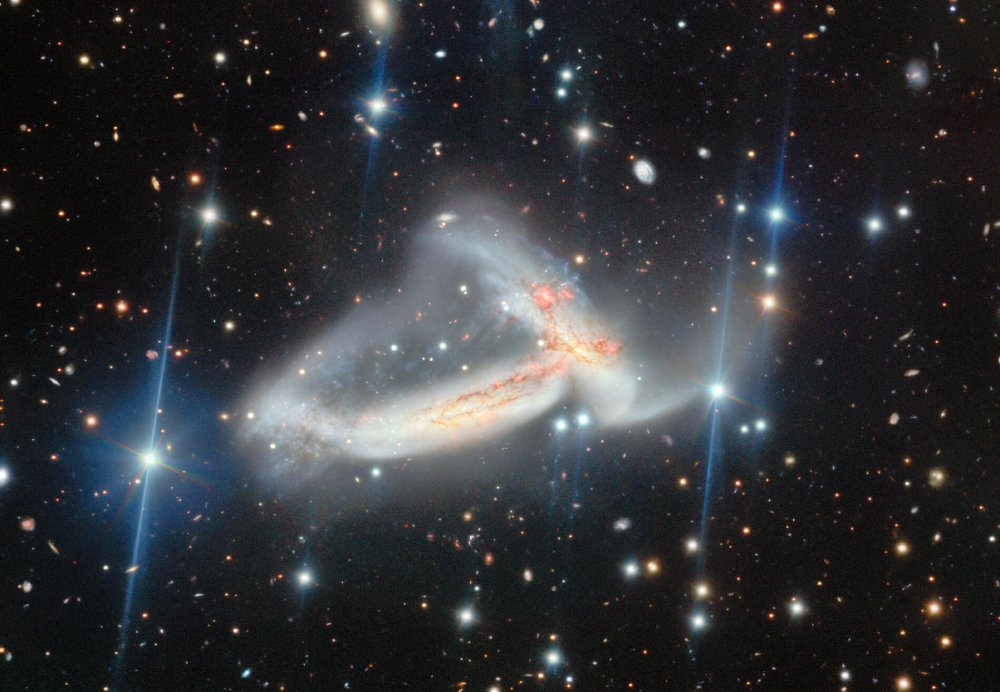
Astronomers using the Gemini North telescope have captured a stunning image of NGC 7253, a pair of spiral galaxies located in the direction of the Pegasus constellation, more than 200 million light-years from Earth.
The two galaxies in NGC 7253 are being pulled toward each other by their mutual gravitational attraction, marking the early stages of a merger process.
Why it matters
This observation provides a vivid example of how gravitational interactions between galaxies can distort their shapes and trigger changes, offering insights into the dynamics of galaxy evolution.
Studying such interacting systems helps scientists understand the processes that lead to galaxy mergers, which are common in the universe and play a key role in shaping the large-scale structure we see today.
Key facts
NGC 7253 is a pair of spiral galaxies located in the constellation Pegasus.
The system is situated over 200 million light-years away from Earth.
The two galaxies are gravitationally interacting and moving toward a merger.
What to watch next
Future observations may reveal more details about the ongoing interaction, such as the exchange of gas and stars between the two galaxies.
Astronomers will likely continue monitoring NGC 7253 to better understand the timescale and outcome of its merger.
